Before yesterday, Microsoft had essentially let Windows rot into a steaming pile of garbage that most of us (Mac people anyway) wouldn’t want to touch with a ten-and-a-half-foot pole. It was horribly ugly, and had seen virtually no innovation in the last decade (or the last three).
Back to the future.
Yesterday, we all got to see what happens when you awaken the sleeping giant in Redmond. Windows 8 is refreshingly innovative, even futuristic in its concepts. It’s clean, modern, fast, and streamlined. It’s well-designed. It has beautiful typography and a fantastic UI. None of these are things we have come to expect from Redmond. None. This is what Microsoft should have been doing all along, rather than wasting time imitating Apple. This is what happens when they think for themselves, and it’s actually pretty impressive. Perhaps the most important thing to take under consideration is this — this is what Windows 8 looks like, nearly a year before its release. Now, just imagine how much can happen in a year of full-force development. Microsoft is scheduled to unveil another round of features and improvements in September at their development conference (similar to Apple’s WWDC) in Anaheim, California.
Now, is Microsoft’s new OS perfect? Heck no. Microsoft made some fairly severe mistakes in its development, mistakes that should and could have been avoided. The single biggest problem with Windows 8 is that they built it on the existing core Windows operating system. This means that all of the existing problems with viruses, malware, spyware, Trojans, and other nuisances will most likely persist on Windows 8. Likewise, Registry problems and DLL issues, along with painfully bad installation procedures, will also likely stick around. So, essentially, in spite of all of these fantastic innovations that Microsoft has done with Windows 8, at its core it’s still the same rotten apple. Time will tell if Microsoft manages to find a way to fix all of these problems.
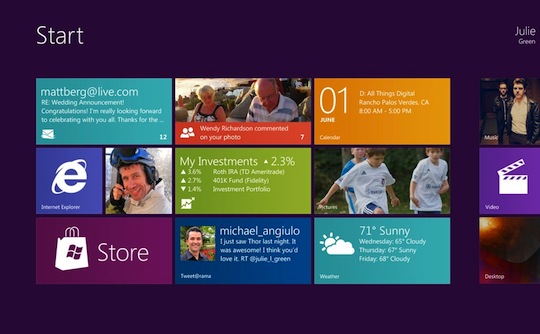
On the surface, however, Windows 8 is downright impressive. The good news is that impressive side of Windows 8 happens to be the side that everyone will be most exposed to. This is great news for Microsoft, and for everyone for that matter. Windows 8 features a beautiful new tile-based UI paradigm that is radically different from anything they’ve ever done on the desktop before. It’s directly inspired by Windows Phone 7′s UI, and really feels like Windows Phone 7 has been scaled up to the desktop. For years, I’ve been saying that Microsoft desperately needs overhaul Windows’ user interface, and it’s really great to see that they’ve finally done just that. I’ve also said that if they really wanted it to be successful, that they should simply have the Windows Phone 7 team design the user interface for Windows 8 on the desktop. And they’ve done just that.
Tiles
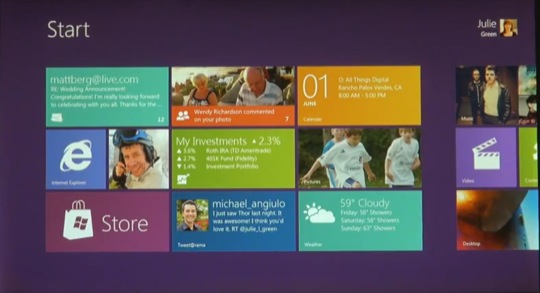
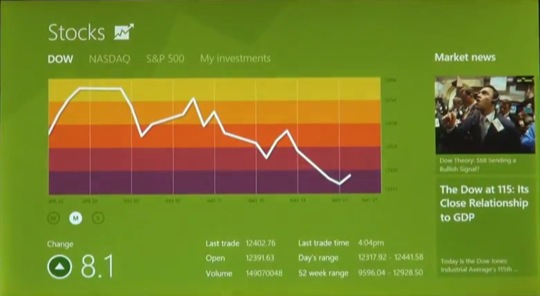
The tile UI concept has been a long time coming. I’ve used Windows Phone 7, and the concept of tiles works better in practice than the concept of icons as used on virtually all other operating systems. This is because tiles can convey more information by definition. For instance, your e-mail tile shows a simple email icon, but also shows the actual title and sender for your last few emails. Your twitter app can show you the most recent reply or direct message, directly on its tile. Your calendar app can show you your next appointment, and your weather app can show you the current weather, along with the forecast for the next few days. Facebook can show you how many notifications you have waiting, and your messaging app can show you your latest text message. This same concept applies to photos, videos, music, contacts, and a very wide variety of apps, all of which find their own ways to display useful information at a glance. Furthermore, the tiles are dramatically easier to touch and manipulate on-screen than small icons are. I can see this user interface scaling really well to the desktop as well, because easier click/tap targets are better just about everywhere, and everyone likes to see vital information at a glance. This is something that applies equally well on multitouch devices and older keyboard and mouse-based devices as well.
Apps and Multitasking
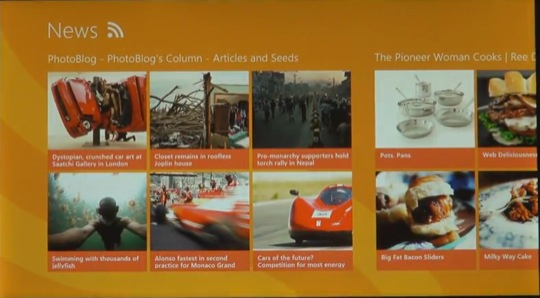
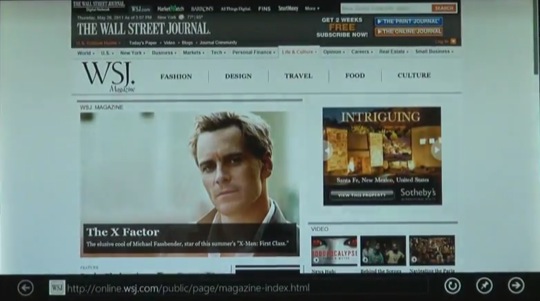
Apps in Windows 8 now have virtually no chrome (user interface elements) whatsoever. This means that things like toolbars, window borders, drop shadows, and all sorts of other space-consuming things have been completely eliminated from the interface, which results in much higher information density. The entire user interface feels like something out of Tron Legacy or some other sci-fi movie. It’s great in that regard.
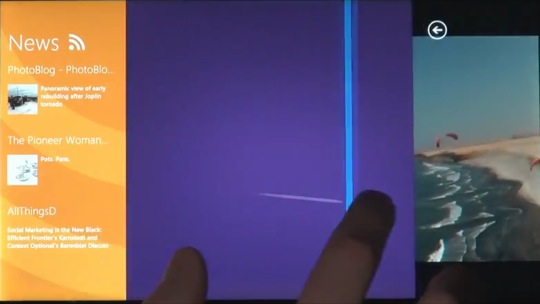
Microsoft took the unique multitasking approach of combining the full-screen app concept from Apple’s iOS with the concept of a tiled window manager. To display more than one app on the screen at a time, you simply begin to drag an app onto the screen from the side by swiping your finger or dragging your mouse, and then pause over the area that you want it to occupy. The app is automatically scaled to fit the vertical height of the screen, leaving enough horizontal space to the right or left for other apps.
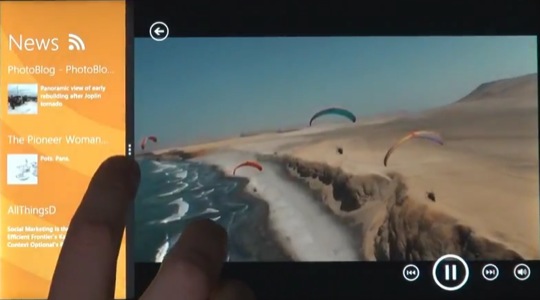
This other space is initially occupied by whatever app you were using before you brought the new one onto the screen, but can also be shared with a third app if you drag yet another onto the screen. This makes excellent use of screen real-estate, with virtually zero wasted space, and very organized information. This is very reminiscent of futuristic user interface concept videos we’ve seen floating around the Internet, and it appears Microsoft was paying attention.
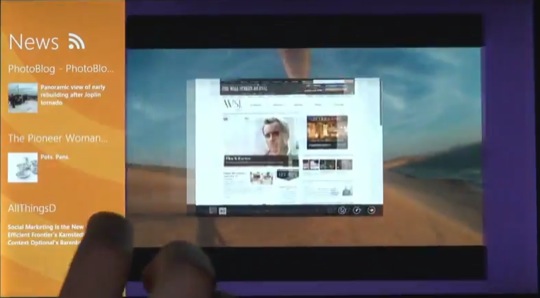
Where it gets really weird is when you need to use what they call a classic Windows app. It’s as if you were able to use an OS 9 application on your iPad, right inside of iOS. Windows 8 has a feature that allows you to turn one of your app spaces into a traditional Windows desktop, complete with task bar and traditional Windows 7-style Windows. This allows you to run apps from 10 years ago right alongside these slick, futuristic “Metro” apps that are built for Windows 8. Of course, I’m not sure bringing the last 20 years worth of Windows’ baggage into the future was a bright idea. All the weaknesses that were left in Windows 8 merely for classic app compatibility will likely turn out to be a nightmare for Microsoft’s developers and users in the long run. We’ll have too see how that pans out.
What if…
What I really think Microsoft should have done is this. Toss the entire core Windows OS (DLLs, Registry, Virus vulnerabilities and all) out the window, and start from scratch with a UNIX based kernel and core OS. Then, simply implement Windows classic via a built-in dedicated VM (created by Microsoft for this purpose, with performance in mind), in much the same vein as VMWare or Parallels. This model would allow a user to have his classic VM infected with a virus, trojan horse, or other nastiness, and simply hit a “reset classic” button that would reset classic by replacing its disk image with a restore image stored somewhere on the machine. Maybe I’m missing something, but this seems like a far more logical way of dealing with the need for classic support than keeping the entire mess of Windows around for the ride. I’m sure performance in demanding apps such as games was cited internally as a reason for doing this, but the disadvantages seem to far outweigh the benefits in this case.
How does it stack up?
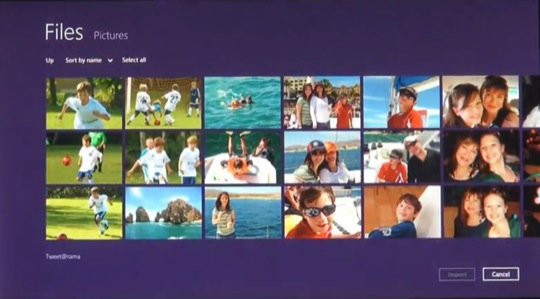
How does this stack up to Apple’s offerings? Good question. In my opinion, the UI makes OS X look rather antiquated (and I’m writing this from within Lion). Windows 8 feels very mature, clean, and minimal. OS X feels very polished, but very traditional. It’s as if Microsoft jumped 10 years into the future, and had a peek at what Apple’s OS offerings would look like then. OS X has kept the same UI concepts that were standard in System 1, way back in 1984. We still have the desktop, icons, menus, trash, windowed apps, close/minimize/zoom buttons and all. Nothing fundamental about the Mac has really changed that much in the last 25 years. iOS has some real promise, and Apple is clearly bringing some solid innovations from iOS to the Mac, but what Microsoft has done feels a lot more robust. Of course, Apple’s quality, attention to detail, and user experience remain unparalleled. Additionally, OS X is time-tested and proven, while Windows 8 may end up being one of those things that looks great in a video, but performs poorly in real life. However, if Windows Phone 7 is any indication, that isn’t likely to be the case. Windows 8 feels like something that would be released alongside OS XI, not OS X. I’m sure Apple has a ton of great stuff up their sleeve for the future. This bold move by their biggest and oldest competitor can only push them to release more, better, faster, and sooner. This, of course, is a really, really good thing for all of us. Apple has produced some really amazing stuff while Microsoft sat around and did nothing. Just imagine what Apple will produce when they’re thrown into a race to the future with their fiercest competitor.
Where does this leave Google?
What about Google? Well, I think Chrome OS stands a decent chance in the enterprise, where many computers act as dumb terminals to give access to a cloud-based solution. The pricing and remote management features of Chrome’s OS and new ChromeBooks will also both remain compelling for business and education buyers.
In the consumer desktop OS market, Google is screwed. It is unlikely that any educated person would buy a Chrome OS-based PC with Windows 8 and Lion being their other two options. I’m not saying Chrome won’t sell — it may do well — in the enterprise, government, and education markets. But on the desktop PCs that now sit in homes all over the world, Windows 8 will eat Chrome OS for lunch. Microsoft is back, baby. And they’re better than ever.
In Closing
With Apple’s Lion, Microsoft’s Windows 8, Google’s Chrome OS, and HP’s WebOS all arriving on the desktop within months of each other, this is going to be one heck of a year. It looks like we’re headed back to the future. This is going to be good.




FLICKR
YOUTUBE
RSS
I am a hardcore PC guy, I much prefer Windows 7 to Mac, and I prefer it for good reasons. I like the taskbar, it is very very superior to the dock, and I loved everything about Windows 7, it got everything right for the most part, it was functional and pretty (the glass look rocked as far as I am concerned.
So it saddens me a great deal that MS is about to shelve all the good stuff they did with Windows 7 in favour of this techincolor, dumbed down monstrosity, and to ass insult to injury, keep the real windows hidden away underneath, but playing second class citizen to a bloody phone UI.
I have no problem admitting, Apple gets what MS refuses to get. Tablets are not PCs, the people who buy them are not the same people who buy PCs, its a new and different market. Tablets are for pure consumption. They are not for anyone who ever needs to create anything on the PC. This new interface is simply going to get in the way for those of use who use our PCs to get work done, rather than for just simply checking email and browsing the web.
Taking your desktop OS and trying to shoehorn it into being a tablet OS is stupid indeed. It creates a substandard Tablet OS without all of the disadvantages of a PC like complex management and updating, and provides a silly looking and cumbersome interface for anyone trying to get work done or who needs more than two programs open at once. I shudder and thinking about how I would get any web design work done while hemmed in by this poorly conceived in a desktop interface, for instance. OF course I could load up the classic desktop. Fine, then why is the stupid touch interface there anyway? It's pointless on a desktop, and downright stupid on any screen larger than 12 inches or so.
Plus, I hate fingerprints on my screen, why the hell do do I wanna start touching it? It's bad enough having a phone smeared by my greasy fingers, I'd rather keep it off my computer, thanks.
It's ironic that the biggest fans of this "new" windows seem to be the form over function mac fanboys who think it's pretty. I'd argue it's butt ugly compared to the sleek and stylish glass of windows 7, but heck, I guess brightly coloured rectangles are the epitome of style these days.
It's also ironic that those same mac users who are excited by this new windows admit it would never make them go back. So if the people who like it will never go back, and the people who don't like it are Microsoft's core users, then who exactly is Windows 8 for? I can promise it's not for me, and business users are gonna see no reason whatsoever to upgrade to this. So who?
Windows 8 is like the politician who tries to please everyone and ends up pissing off his base resulting in a crushing electoral defeat.
I find myself asking what I will do if this really is what MS sticks me with? Linux is not a real option, so Mac? Now wouldn't that be the perfect irony.
- spam
- offensive
- disagree
- off topic
LikeThe tiles on the desktop (if we can still call it that) looks good, but will it scale? They show a screen with nine tiles. Quick look in my Applications folder = 220 applications. I don't think that is atypical. So how will this UI look when it has to display 220 tiles?
- spam
- offensive
- disagree
- off topic
LikeKeil Miller, I hear you. What I still don't understand is many of these Windows users just hate Apple with a passion. I am a Windows user (17 years software developer here) but I prefer Mac and now Windows 8 looks good to me so far.
I drive a decent, everyday car but I don't bash or hate what Ferrari has and call Ferrari over price or hate Ferrari for no reasons. Just so silly to me.
- spam
- offensive
- disagree
- off topic
LikeAbsolutely. You worded that well. :)
- spam
- offensive
- disagree
- off topic
Like@Jas An Apple computer is a P.C. It stands for Personal Computer. And the reason to hate windows is because it doesn't work well, is full of bugs and viruses, has a weird task bar thingy, apps install files all over... The list goes on. There are many better options out there, but most people use Windows and hate all others just because they never used anything else. Or thinks that a Mac or Linux can't open a fucking MS word file.
- spam
- offensive
- disagree
- off topic
LikeJustin: I searched the article for the word "battery," to be sure that my initial perception was correct. You say nothing about the challenges that make tablet production unique. It's not rocket science to put a pretty shell on top of an existing operating system or to create new connections among applications so that the appearance of consolidation is created. What is rocket science is redesigning an existing operating system so that it minimizes its demands upon CPUs and conserves battery life. I see no signs in the Windows 8 demo that this work has been done. Microsoft doesn't need to sell new desktop machines; it needs to sell tablets and ultralights. Unless the new system jettisons the creeping crud that is the Windows legacy, it will never be able to compete in battery life and CPU access speed with iOS and Android.
- spam
- offensive
- disagree
- off topic
LikeI am a Mac fan and very impressed with Windows 8. Unlike most Apple haters, I am willing to admit when MS is doing things right and they have shown it here with the latest Win 8 demo. The thing I fail to understand is most Apple haters would just bash anything (even the positives that Apple has to offer and everyone knows they have tons, maybe not your cup of tea but you must give credits to Apple for their innovation). This just seem very silly to me.
Windows 8 is a prime example that competition helps us all, especially the consumers. I am now excited about Win platform again and maybe just maybe will buy another PC after leaving it for 7 years now.
In my case, I will use both platforms (Apple and PC). Why not? This is technology and not religion. Stop hating and just appreciate living in a wonderful world with all these tech toys.
- spam
- offensive
- disagree
- off topic
LikeGreat article. And I agree. A polished turd is still a turd. M$oft should start from scratch, but most people don't care if it only works half the time. If they can run the same apps as their friends and have it on a 300$ HP... Then why would m$oft bother? They are still making money.
It's interesting to see how well the xbox 360 works compared to windows.
- spam
- offensive
- disagree
- off topic
LikeReally, you're still doing that? "M$oft"?
- spam
- offensive
- disagree
- off topic
Like@Greg and Ben, thanks! I really appreciate it.
@Jay, thanks for reading and giving feedback. I don't expect you to see it the same way I do, I just try to be as objective as possible, and let the chips fall where they may.
- spam
- offensive
- disagree
- off topic
LikeI understand this is an Apple-Centric site and you have to dismiss Microsoft and/or Windows as many times as possible, but have you actually installed Vista or Windows 7 (or the leaked Windows 8) ? It's a heck of a lot quicker than Snow Leopard installations.
Do you discount the innovation of Windows 95? That was a huge leap from Win3.x.
Do you understand Malware and that most Malware now uses the same tactics that the Mac Defender uses? It's called social engineering.
I do try to stay as objective as possible in my approach to computing and technology. I've never had an infection myself in the 15+ years I've had my own PC.
You write about Viruses/Trojans as if every Windows machine has one, which is false and you Sir are just as bad the scaremongering Mac Defender scareware.
There are so many false and usual Apple Fanboi statements it's quite difficult to understand what you are trying to get across, you praise MS one sentence then seem to retract your praise with the next.
PS: ChomeOS in my humble opinion won't catch on. The Machines priced up over the rolling contracts add up to a significant amount of dosh, you could buy an Apple machine for the price of a ChromeOS netbook. It took them this long to release something that is not innovative at all, it's a blank UI with Chrome web browser baked in. MS just spanked Google.
PSS: Apple have really got to catch up now. It will be interesting to see how/what the respond with, for now I'll say MS just spanked Apple.
PSSS: I use Windows & FBSD myself, have an Android phone and support OS X machines and their users.
- spam
- offensive
- disagree
- off topic
Like"PSS: Apple have really got to catch up now."-Jay
With all due respect, Apple does not have to "catch up" to a mere announcement. When the product actually exists in the wild, then we can see who has to catch up to whom.
- spam
- offensive
- disagree
- off topic
LikeYou used the word, "fanboi" so I immediately discount anything you have to say. It's PPS and PPPS, not PSS and PSSS, so I see you have problems with acronyms. You said, "Apple have really got to catch up now.", proving you don't understand tenses. Why would I even bother considering your opinion?
- spam
- offensive
- disagree
- off topic
LikeReally enjoyed reading this. The honesty and analysis found in this post are really lacking across the tech blog/website ecosystem.
It's great that Microsoft is finally pushing Apple, rather than vice-versa. Apple is going to have to step up its game now and I'm looking forward to using the result of both companies' efforts.
- spam
- offensive
- disagree
- off topic
LikeRefreshing to see enthusiasm like this! And here I thought Mr. Lowery only saw the world through Jobs-colored glasses. I couldn't imagine a dyed-in-the-wool Mac guy would have seen the benefits along with the drawbacks of what seems to be the Windows 8 approach, but here it is. Both, and not even a heavy bias towards the negative (though of course the legacy support WILL be the negative!) Thanks for the article.
- spam
- offensive
- disagree
- off topic
LikeYes, legacy support WILL be the negative. And not a minor one, but the negative that will make this conglomeration of WP7 with W7 problematic as both a tablet OS and as a desktop/notebook OS.
Coming out with a new tablet OS that uses some portions of a desktop OS and desktop applications, is like coming out with a new desktop OS that still demands using the command line for many things.
Microsoft can't advance into the future if it still has one foot firmly planted in the past.
The problem is that, as in 2001 when Bill Gates was pushing the desktop version of Windows for use in tablet PCs, Microsoft still sees tablets as smaller, keyboardless PCs... which they are not.
Google, HP, and Apple do understand that mobile computing is not the same as desktop computing, and so they developed operating systems specifically for tablets instead of trying to shoehorn a desktop OS into tablets.
On top of this, Microsoft has admitted that desktop applications (like Excel demoed in the video... as if you would want to use this on a 7" or 10" tablet) will NOT run on ARM tablets. So what is the point of basing your tablet OS on Windows 7?
Intel tablets would run Windows desktop applications, but aside for using desktop applications on a small touch-screen, these tablets run much more slowly than the ARM tablets, they use more battery life, and they run hotter requiring better ventilation to bring the temperature down.
On the desktop side, sticking a Windows Phone 7 interface on top of Windows 7 doesn't make much sense either. The large tiles are less useful than current widgets, and it adds another UI to an existing UI making it jarring as you go from one to the other.
Hopefully Microsoft will change course and develop a tablet-specific OS, instead of trying to force a desktop OS into tablets.
- spam
- offensive
- disagree
- off topic
Like